


Some thoughts on Brands & Business
The Value of Brands
It is widely acknowledged that a significant part of a company's assets is contained in the intangible and long-term value of its brand(s).
Warren Buffet sees this as building a 'monopoly in the mind of the consumer'.
In a display of the power of intangible assets, BrandFinance calculated the combined brand value of the world's top ten brands to be US$2.4 trillion in 2025. That's US$ 2.4 trillion for things people cannot see or touch, just what they perceive.
But you do not have to accept these figures. IPO and M&A activity show how people's perceptions of a product, service, or corporation can price a company at several times its tangible assets. We have also all seen what happens to a company's share value when perceptions dramatically shift against it.
Brand versus Commodity
Our definition of a brand
A collection of perceptions, springing from people’s total experience of a company, product, service, or entity. These perceptions give distinction, generating (or in negative cases reducing*) value.
Our Definition of a commodity
A product or service that lacks distinction or perceived value so that (in a free market) it is at the mercy of price competition.
*Perceptions can turn negative which reduce (or in the worst case totally destroy) value. “We have all heard the phrase, ‘Branded a liar’.
Our Mindset
Brandstorm Business fuses creativity with business realities. Its strategy sessions are inspired by the genius of Dr Edward de Bono’s ‘Six Thinking Hats®’ approach to different modes of thought.
Six Thinking Hats® is a registered trademark of Edward de Bono Ltd. We are not affiliated with or endorsed by Edward de Bono Ltd.
AI with Human Curation

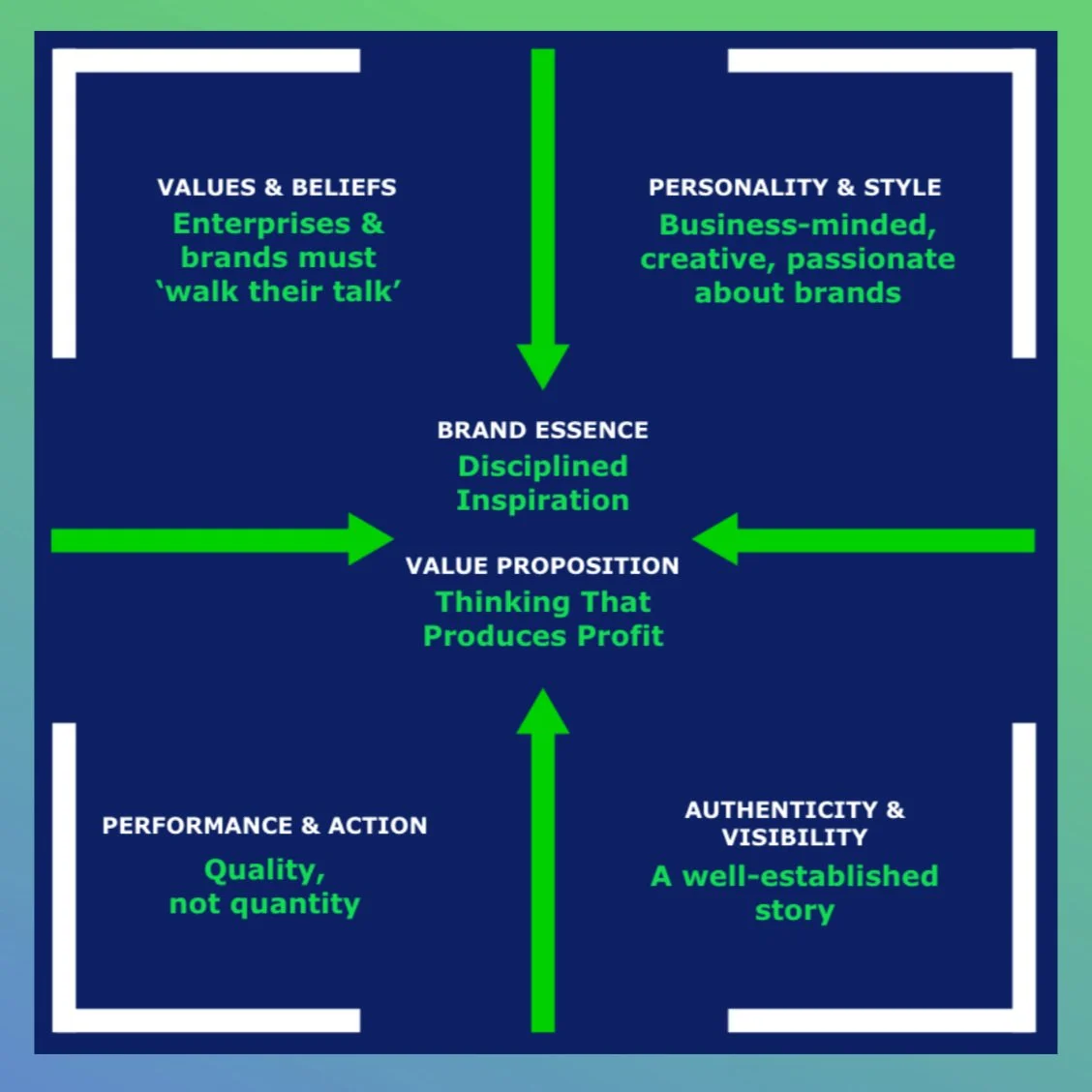
Our brand DNA
-
Disciplined - seeking out and analysing the facts; being grounded in business realities.
Inspiration - creativity and collaboration to achieve breakthrough thinking.
-
Enterprises & brands must 'walk their talk'.
Trust is essential for brand success, and it can only be earned when brands live up to their communications promises.
The best way to achieve this is by integrating brand strategy with business planning and processes to ensure that actions result in optimal brand experiences and a fair reward for the value created.
-
Quality, not quantity
We help our clients achieve higher profitability through creative thinking, practical planning, and thoughtful guidance, based on thorough preparation, analysis and experience.
We concentrate on a limited number of clients to ensure we allocate quality time and maintain a high level of commitment. In short, "we don’t take on more than we can chew".
-
Business-minded, creative, & passionate about brands
Thoughtful, inquisitive, embracing change and new ideas, optimistic yet rooted in what is possible.
Our style is to bring clarity to complex issues, to make the business of branding understandable without becoming simplistic.
-
A well-established story
Prior to 1997, Anthony Pettifer spent 20 years with global advertising giants J. Walter Thompson, Leo Burnett, and DDB Needham. In a succession of increasingly senior business development and strategic planning assignments, he honed the skill of bringing clarity to complex strategic issues and realised that to understand what is truly meant by a ‘brand’ is fundamental to the long-term profitability of any enterprise.
-
Thinking That Produces Profit
Avoiding cookie-cutter, theoretical solutions, our extensive experience combined with brand-centred business strategies delivers 'thinking that produces profit'.
How brand-centred business strategy produces profit
All those involved with a brand—customers, influencers, employees, distributors, suppliers, contractors, regulators, and investors—have perceptions that can make them more or less 'brand loyal.' These perceptions are driven by brand experiences, which in turn are driven by performance. Quality performance that is distinctive and relevant to stakeholders’ needs is based on a strategy defined by the Brand DNA and made possible by business plans and processes. The more stakeholders feel an emotional connection with a brand through their experience, the more positive will be their attitudes and behaviour - leading to clear economic benefits. Hence, ‘thinking that produces profit’.
Thinking that produces profit. click here for YouTube https://youtu.be/DoROzc2GJbE
Out of interest, we asked AI this question…
How does brand optimisation lead to bigger profits?
The AI answer is a good summary of generally accepted thinking
Brand optimization is the strategic process of refining a brand’s identity, messaging, and customer experience to enhance its market position. By creating a strong, consistent brand image, businesses can increase customer loyalty, leading to repeat purchases and higher customer lifetime value. Effective brand optimization ensures that messaging resonates with target audiences, improving engagement and conversion rates.
Additionally, a well-optimized brand can differentiate itself in a crowded market, allowing for premium pricing and reduced price sensitivity. Enhanced brand reputation fosters trust, which is crucial for attracting new customers and retaining existing ones. Moreover, optimized branding improves visibility across various channels, driving organic traffic and enhancing marketing effectiveness.
Ultimately, as brand equity grows through optimization, companies can experience greater market share and profitability. This synergistic effect of loyalty, differentiation, and increased visibility positions the brand to capitalize on opportunities, leading to sustained revenue growth and larger profit margins.
Design is a proxy for quality.
If a brand identity looks like it was assembled without thought or judgement, or entirely delegated to AI to the point that it looks generic, the subconscious assumption is that the service or product was assembled with the same lack of care. A ‘poor quality’ brand identity isn't just an aesthetic failure; it’s a financial one. It forces you to work twice as hard to prove the brand's value because its visual language is already undermining credibility.